
You can feel revenue leaking after the sale. Accounts churn without warning, support costs more than it should, renewals get harder, and expansion never happens. What you cannot do is point to exactly where, or what each leak costs. A customer experience audit is how you find out.
Done properly, it is not a survey or a satisfaction score. It is a structured review of everything that happens after a customer signs, built to find where you lose customers, margin, and growth, and to put a number on each. That number turns a vague sense that something is wrong into a ranked list of fixes with a business case.
What a customer experience audit is
A customer experience audit maps your post-sale experience, from onboarding through support, communication, renewal, and expansion, and finds where it breaks. It works from the data you already hold: churn, support tickets, renewal rates, billing, and account records, plus a check on what customers actually experience. The output is not a description of your journey. It is a diagnosis: here is where you are losing money, here is how much, here is what to fix first.
What a good audit finds
The leaks are specific, and they repeat across B2B companies:
Onboarding drop-off. Customers who sign and never reach value, writing off the acquisition cost you already paid.
Silent accounts. Accounts going quiet months before they cancel, with nobody watching.
Cost to serve. Support volume inflated by contacts that exist only because something failed the customer the first time.
Renewal risk. Accounts heading for a hard renewal because value was never proven across the term.
The promise gap. The distance between what sales promised and what delivery gave, which drives complaints and churn no product fix will solve.
A good audit finds these and sizes each one in your own money.
What it must deliver to be worth doing
Most customer experience audits fail at the last step. They produce a report full of findings, a maturity score, and a slide deck, and then nothing gets built. The findings are true and the revenue keeps leaking.
An audit is only worth doing if it ends in a plan you can act on:
Your top three to five problems, ranked by what they cost you.
A number against each, sized from your data, not a generic benchmark.
A recommended first fix, scoped and ready to build.
The plan should be the first step of the build, not the deliverable. If the audit ends at a report, you have bought a diagnosis with no treatment.
How to judge a customer experience audit
When you choose who runs it, look for four things: it works from your own data, not generic benchmarks; it ends in a costed, ranked action plan, not a score; it names a specific first fix you can build; and the firm running it can build that fix, not simply recommend it. An audit from someone who cannot build the fix is a report by another name.
What it costs and how long it takes
A focused B2B customer experience audit runs about three to six weeks. At ExperienSync, the diagnostic is priced from 5,000 to 16,000 euros depending on scope, and it is built as the first step of a fix rather than a standalone report. It ends with three to five problems ranked by cost and a recommended first build, so the next step is obvious.
What to do next
If you can feel the post-sale leak but cannot name it, a customer experience audit is where to start. Map the journey, find the breaks, size them, and rank them.
This is Phase 1 of how we work at ExperienSync: we run the audit, size the cost of each problem, hand you a ranked plan, then build the top fix and prove the result. Find the problem, build the fix, prove it. See how we work and what we solve, or score your experience to start.
Frequently asked questions
What is a customer experience audit?
What should a customer experience audit include?
How much does a customer experience audit cost?
Who does customer experience audits for B2B companies?
More on Strategy

Will AI Replace Your Customer Experience Team?
No. In B2B, AI takes the routine work and moves your team to design, complex accounts, and overseeing AI. Here is what changes, and why a designed experience matters more.

Do You Need a Customer Experience Consultant or an In-House Team?
Hire a customer experience consultant, build in-house, or buy software? The answer depends on speed, expertise, and whether CX is permanent. Here is how to decide.
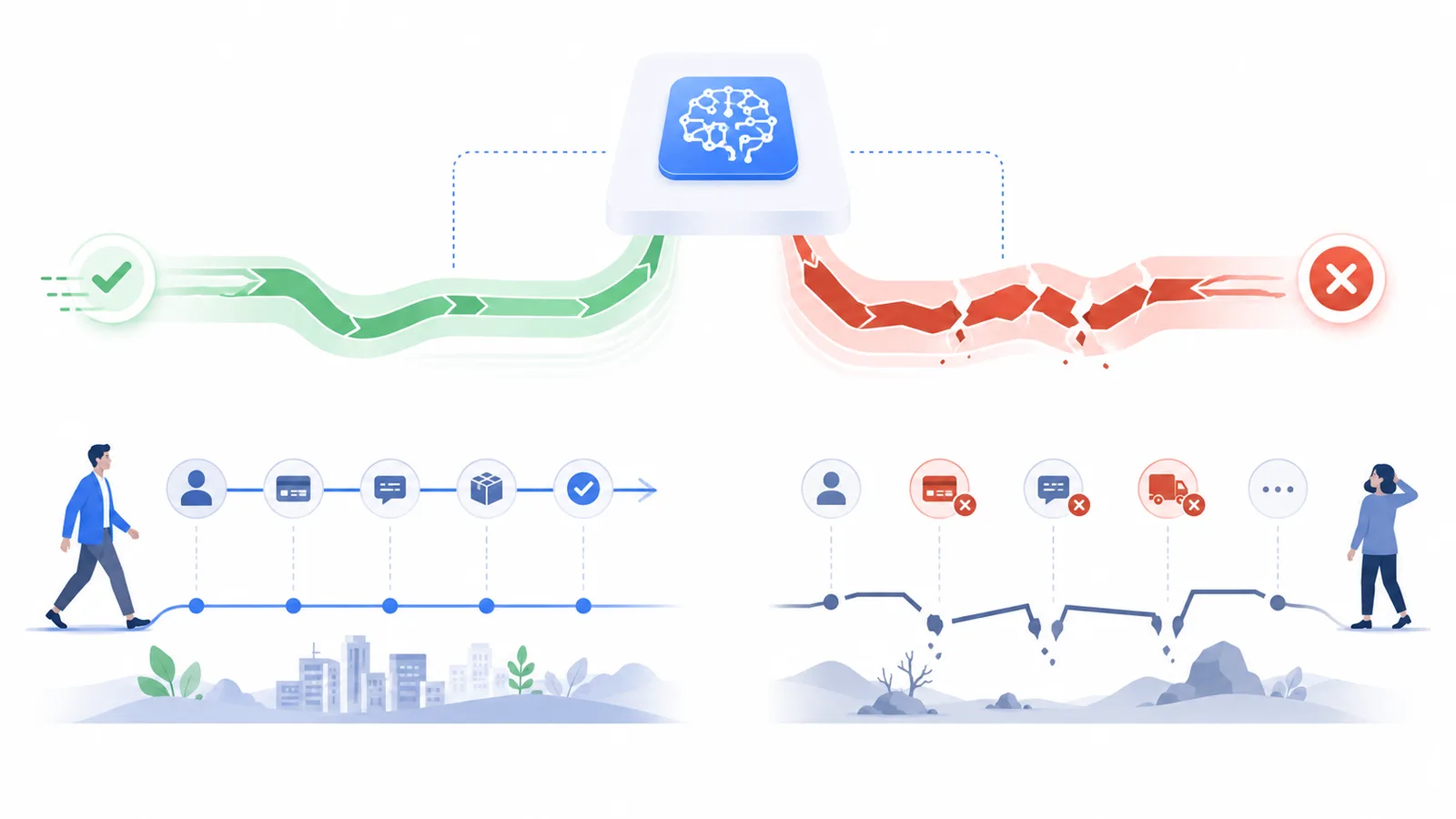
Does AI Improve Customer Experience? Only If You Fix It First
AI can improve B2B customer experience, but only on an experience that works. On a broken one it makes bad service faster. Here is what to fix before you automate.