
No. In B2B, AI is not replacing your customer experience team. What it is doing is taking the routine, high-volume work off them and moving the human job up: toward designing the experience, handling the complex and high-stakes accounts, and overseeing the AI itself. The teams that treat AI as a way to cut headcount get worse outcomes. The teams that use it to free people for judgment win. Here is what changes, and what it means for how you staff and design your post-sale experience.
What AI takes over
AI now reliably handles the repeatable, rules-based work, and it does it at scale:
- Intake, triage, and routing: classifying and prioritising requests, sending them to the right owner with context already gathered.
- Routine resolutions: access resets, status and SLA checks, billing and invoice lookups, and common how-to questions answered from your documentation.
- Drafting and summarising: first-draft replies, summaries of long account threads, suggested answers from the knowledge base.
- Proactive signals: monitoring account health, flagging churn risk and expansion signals, and alerting a human before an account slips.
This is real work, and handing it to AI is a genuine gain, when the experience underneath is designed. On a broken process, the same automation scales the failure faster.
What stays human, and why B2B makes it non-negotiable
B2B relationships are high-value, multi-contact, and contractual, so the moments that decide a renewal still need a person:
- Complex problems that need real product expertise or cross-team coordination.
- Escalations and recovery, where a dispute or a churn-risk conversation turns on trust and discretion.
- Policy, legal, and security decisions: interpreting a contract, a compliance limit, or approving a change that moves money.
- Strategic accounts: the quarterly review, the roadmap conversation, the renewal and expansion negotiation.
None of these can be credibly owned by a bot, and in B2B they are where the revenue is. A wrong AI answer on a high-stakes account does not save cost. It costs the account.
How the job changes
The customer experience role does not disappear. It splits into three jobs that grow in value:
- Experience design. Less scripting individual replies, more designing the journey the AI runs on: what AI can and cannot handle, where a human must step in, and how context follows the customer across channels.
- Complex account stewardship. Owning the relationship and the outcome on strategic accounts: executive communication, cross-functional coordination, and acting on the churn and expansion signals the AI surfaces.
- Overseeing the AI. A new job: someone accountable for the quality of AI-handled interactions, the escalation rules, the knowledge the AI draws on, and the metrics, measured on resolution quality and retention, not on deflection.
Why this raises the value of a designed experience
Notice the through-line. Every one of those growing jobs is about design and judgment applied to the experience, not about answering tickets. AI does the answering. What it cannot do is design the experience it operates in, or decide where the human line sits. And AI is only as good as the experience underneath it: point it at a designed post-sale journey and it multiplies the result; point it at a broken one and it scales the mess at speed.
So the arrival of AI does not reduce the need to design the post-sale experience. It raises it. The companies that win are not the ones that automate the most. They are the ones that designed the experience first, then let AI run it.
What to do next
Before you cut a customer experience role or buy another AI tool, ask two questions: is the post-sale experience the AI will run actually designed, and have we defined where AI hands off to a person. If the answers are no, that is the work to do first.
Designing that experience and the human-AI boundary is what we do at ExperienSync. We find where the post-sale experience loses customers, build the fix, and prove the result, so that when you add AI, it runs on something that works and your team is freed for the judgment work that keeps accounts. See what we solve and how we work, or book a call. For the fuller case, see why AI needs a designed experience to improve CX.
Frequently asked questions
Will AI replace customer service and customer experience teams?
What customer experience work does AI take over, and what stays human?
How does the CX or customer success role change with AI?
Should you cut CX headcount because of AI?
More on Strategy
Do You Need a Customer Experience Consultant or an In-House Team?
Hire a customer experience consultant, build in-house, or buy software? The answer depends on speed, expertise, and whether CX is permanent. Here is how to decide.
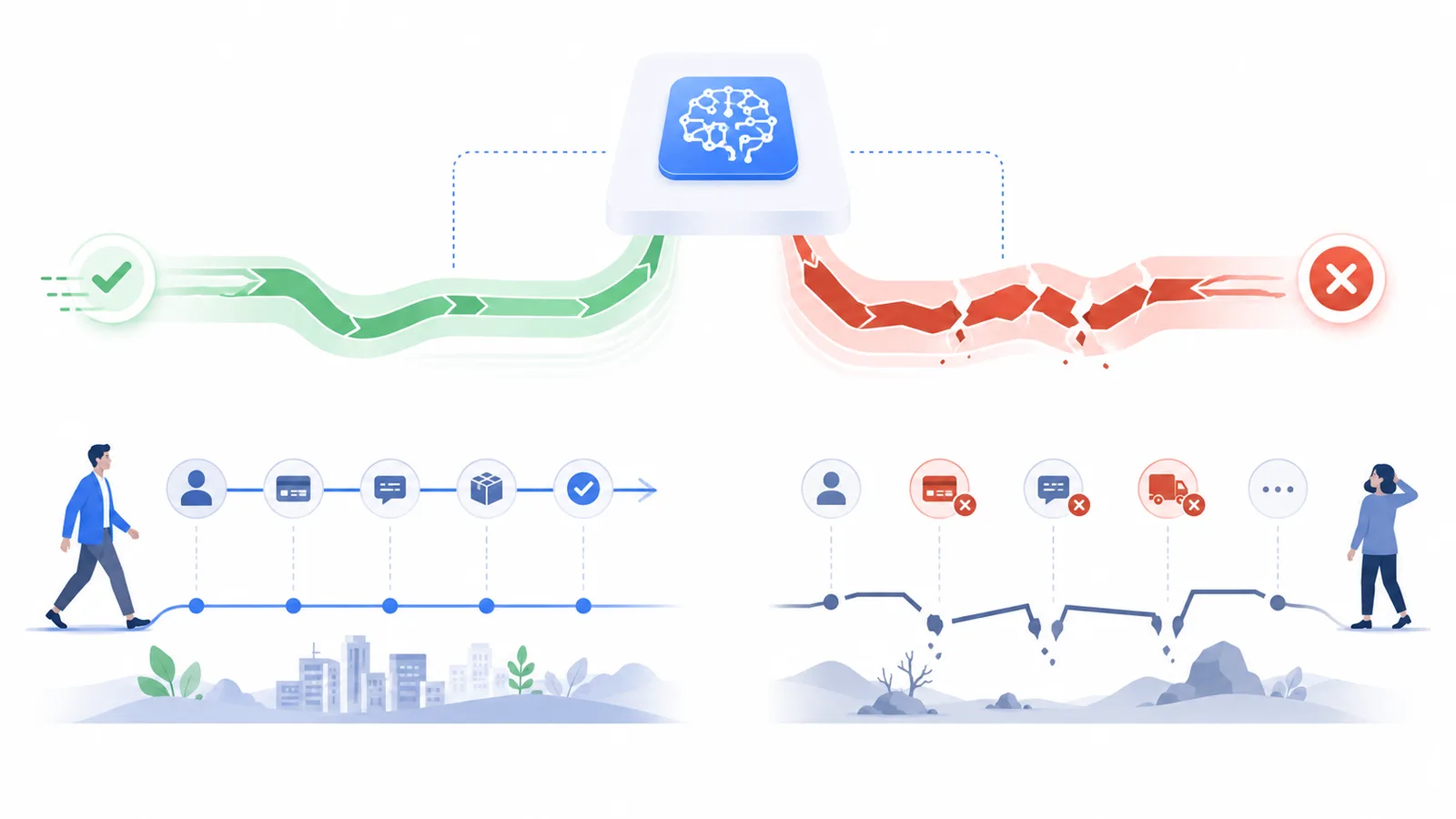
Does AI Improve Customer Experience? Only If You Fix It First
AI can improve B2B customer experience, but only on an experience that works. On a broken one it makes bad service faster. Here is what to fix before you automate.
How to Choose a Customer Experience Firm for IT Services
IT services clients are lost during implementation, not at renewal. Here is how to choose a customer experience firm that fixes that, not one that just staffs your helpdesk.