
You are about to spend money on outside help because something after the sale is costing you. Customers churn before renewal. Support costs more than it should. Accounts go quiet and you find out at renewal. So you start looking for customer experience consulting.
Here is the risk. Most of what is sold under that label ends at a report. You pay for a diagnosis, get a slide deck and a list of recommendations, and the problem keeps running while the document sits in a drive. The churn you hired someone to stop carries on. The acquisition cost you already spent keeps getting written off. You paid for advice, not a fix.
This guide shows you how to screen for help that closes the gap, not help that only names it.
Name the problem and its cost first
The fastest way to waste money on CX work is to brief it as "improve our customer experience." That gets you generic advice priced like bespoke work.
Before you talk to anyone, write the problem in commercial terms. Not "our CX needs work." Instead: "Customers drop off in the first 90 days and each one is a full acquisition cost written off." Or: "Quiet accounts cancel at renewal with no warning." Or: "Support handles the same query four times and our cost to serve is climbing."
When you can name the break and what it costs, two things happen. You filter out the providers who only sell theory, and you give the serious ones something to size and price against.
Separate the people who advise from the people who build
The CX market splits in two. Most providers diagnose. Few build the fix.
That distinction matters because the gap you are paying to close is execution, not insight. Most companies already know where their post-sale experience leaks. What they lack is someone who designs the fix, builds it, and stays until the number moves. The shortfall is in the doing, not the knowing.
So ask directly: do you build the fix, or do you hand me a plan and leave? Who writes the customer emails, configures the tools, redesigns the process, trains the team? If the answer stops at "we deliver recommendations," you are buying a report. Price it as one.
Customer experience consultant or customer retention consultant?
Search for outside help and you will meet several labels: customer experience consultant, customer retention consultant, CX consulting. In B2B post-sale work they land in the same place. Retention is the financial result. The experience your customers get after the sale is the machine that produces it. Judge every provider, whatever their title, on the same split above: do they advise, or do they build.
One warning sign specific to the retention label. A provider who talks mainly about win-back campaigns and discount offers is treating the symptom at the point of cancellation. The leak sits earlier: onboarding that stalls, accounts that go quiet, renewals nobody prepared. The work that moves the number finds where customers stall or go silent, builds the fix, and proves the result against a baseline.
Make them tie the work to a number
Good CX work ends with a financial figure, not a recommendation.
Ask any provider three questions. What metric will move? What is the target? What is that worth to my business in retained revenue or reduced cost to serve? If they cannot answer in commercial terms, they are selling activity, not a result.
Make them set a baseline before the work starts. Without a baseline you cannot prove anything changed, and "it feels better" does not survive a conversation with your CFO.
What that number is worth shows up in public data. McKinsey's 2025 analysis of B2B software companies found top-quartile performers run net revenue retention of 113 percent, growing 13 percent a year from existing customers alone, while bottom-quartile peers sit at 98 percent and shrink before winning a single new customer.
Ask what happens if it does not work
This is the question that sorts the field.
A report-seller's engagement ends at handover. A builder's engagement ends when the metric moves. Ask what happens if the target is missed on work they control. The answer you want is that they keep working until it does, at no extra cost, within a defined window. If the engagement ends the moment the deck is delivered, the risk sits entirely with you.
You already hold your vendors to this standard. McKinsey's B2B Pulse research (2025) found eight in ten B2B decision-makers actively look for a new vendor when performance guarantees are not offered. Apply the same bar to the people you hire to fix retention. Our own rule is on the table: if the target is not hit on work we deliver and control, we keep building at no additional cost.
Know what scoped work should cost
Vague briefs get vague quotes. Scoped work has real ranges.
For mid-market B2B, expect roughly these bands. A focused diagnosis that sizes the problem and ranks the fixes runs around €5,000 to €16,000. A 90-day build that fixes one journey and proves the result runs around €12,000 to €28,000. Ongoing governance that keeps it working runs around €1,500 to €4,500 a month. The numbers are illustrative; your baseline gets set from your own data.
If a quote comes in far below that, you are probably buying a report. Far above, and you are likely paying for a large firm's overhead and junior staff. Either way, the price should map to a defined problem and a target, not to hours.
What to do next
Before you brief a single provider, write one paragraph: the problem, where it happens after the sale, and what it costs you a year. Use your own numbers, your account count, your average contract value, your churn or cost to serve.
That paragraph does two jobs. It filters out everyone who only sells advice, because they cannot price against it. And it tells the builders exactly what to scope. Find the problem, build the fix, prove the number. That is the standard to hire against.
That one-paragraph brief is exactly what our first conversation works from. If you want the starting picture before you write it, run the self-assessment; it takes minutes and shows where your post-sale experience leaks. Or bring the problem straight to a call and we will size it with you.
Frequently asked questions
What is customer experience consulting?
How much does customer experience consulting cost?
What is the difference between CX consulting and CX implementation?
How do I know if a CX consultant is worth it?
What does a customer retention consultant do?
Is a customer retention consultant different from a customer experience consultancy?
More on Strategy

Will AI Replace Your Customer Experience Team?
No. In B2B, AI takes the routine work and moves your team to design, complex accounts, and overseeing AI. Here is what changes, and why a designed experience matters more.

Do You Need a Customer Experience Consultant or an In-House Team?
Hire a customer experience consultant, build in-house, or buy software? The answer depends on speed, expertise, and whether CX is permanent. Here is how to decide.
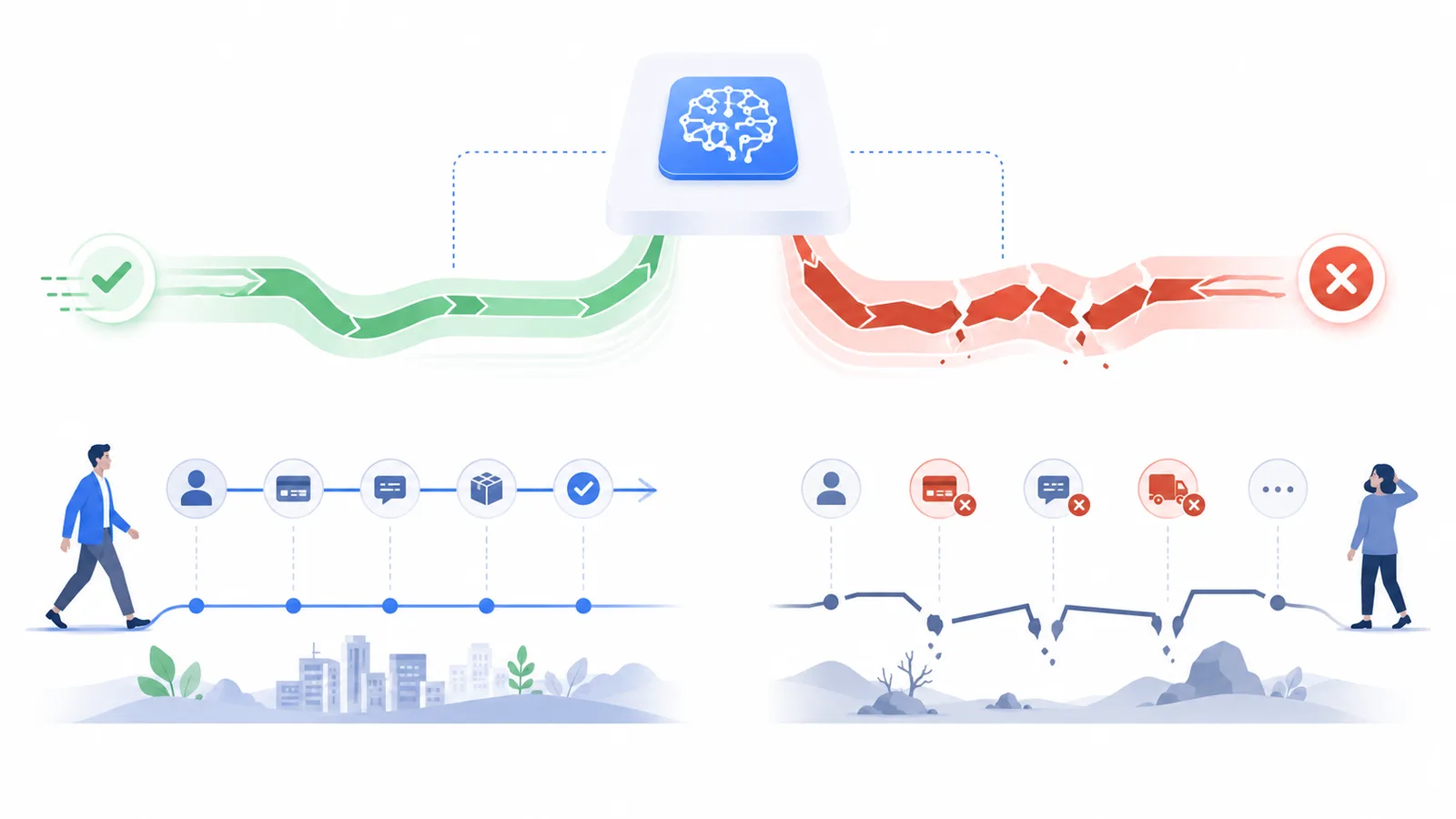
Does AI Improve Customer Experience? Only If You Fix It First
AI can improve B2B customer experience, but only on an experience that works. On a broken one it makes bad service faster. Here is what to fix before you automate.