
You have a customer experience strategy. It is a document. It names your segments, your journey stages, your target metrics. It cost weeks of work to produce. And your customers are still going quiet in month three and leaving at renewal.
That gap between the strategy and the result is the most expensive thing in most B2B companies. A strategy that lives in a slide deck protects no revenue. Every customer who churns while the plan sits unbuilt is a full acquisition cost written off, plus the contract value you now replace from scratch.
A strategy you do not build is a cost
The point of a CX strategy is not the strategy. It is the experience the customer gets after they sign: how they are onboarded, communicated with, supported, and renewed. If the strategy never becomes a built experience, you paid for analysis and got nothing back.
Most CX strategies fail at the same point: the handoff from plan to build. The journey map is drawn. The metrics are chosen. Then nobody owns the work of changing what the customer experiences, and the document goes stale while the problems it identified keep costing money.
Start with the problem and its cost, not the audit
The usual advice tells you to research your audience, map every journey, and pick your metrics first. That order is backwards for a commercial buyer. You do not need to map all of it. You need to find the one post-sale break costing the most and fix that.
Pick the problem by its cost. Where do customers stall in onboarding? When do they go silent? Which renewals are you losing without warning? Each of those has a number attached. Size it before you design anything.
To size it, take the rate at which customers leave at that break, multiply by your average contract value, and add the acquisition cost you spent to win each one. That gives you the annual revenue the break is costing. Run the same sum on every candidate problem and the most expensive one is where you start. The numbers are illustrative; your baseline gets set from your own data.
Map one journey, not the whole business
A journey map is useful when it points at money. Map the route a customer takes through the journey you chose, from contract to the outcome they bought. Mark where they stall, go quiet, or repeat themselves. Those friction points are where revenue leaks.
Skip the exercise of mapping every segment and channel before you act. That produces diagrams nobody builds from. One journey, the costly one, mapped well enough to build the fix.
Measure what predicts revenue, not satisfaction alone
NPS, CSAT, and CES tell you how a customer felt about an interaction. Useful, but they lag. By the time satisfaction drops, the customer is often already deciding to leave.
Track leading metrics that move first: time to first value in onboarding, months of silence between meaningful contacts, the gap between a risk signal and someone acting on it. These predict renewal earlier than a satisfaction score does. Tie each one to a financial number, so the strategy is judged on revenue retained and cost to serve, not on a survey average.
The mistakes that drain the strategy
Three failures show up most:
- Feedback collected and never acted on. You pay for the survey tool, the insight sits unused, the problem it named keeps costing money.
- No single owner of the post-sale experience. Five departments touch the customer, each works its piece, the customer feels the cracks.
- The plan overbuilt. Too many segments, too many metrics, too much process. Complexity stalls execution. A narrow plan that ships beats a complete one that does not.
What to do next
Stop treating the strategy as the deliverable. Find the one post-sale problem costing you the most. Size it in revenue or cost to serve. Build the fix for that single journey. Prove the number moved. Then move to the next problem.
That is the order: find the problem, build the fix, keep it working. A CX strategy earns its keep when it changes what the customer experiences and shows up in the renewal rate, not when it is finished as a document.
Frequently asked questions
What makes a B2B customer experience strategy actually work?
Where should I start with a CX strategy?
Which CX metrics matter most for retention?
Why do most CX strategies fail?
More on Strategy

Will AI Replace Your Customer Experience Team?
No. In B2B, AI takes the routine work and moves your team to design, complex accounts, and overseeing AI. Here is what changes, and why a designed experience matters more.

Do You Need a Customer Experience Consultant or an In-House Team?
Hire a customer experience consultant, build in-house, or buy software? The answer depends on speed, expertise, and whether CX is permanent. Here is how to decide.
Does AI Improve Customer Experience? Only If You Fix It First
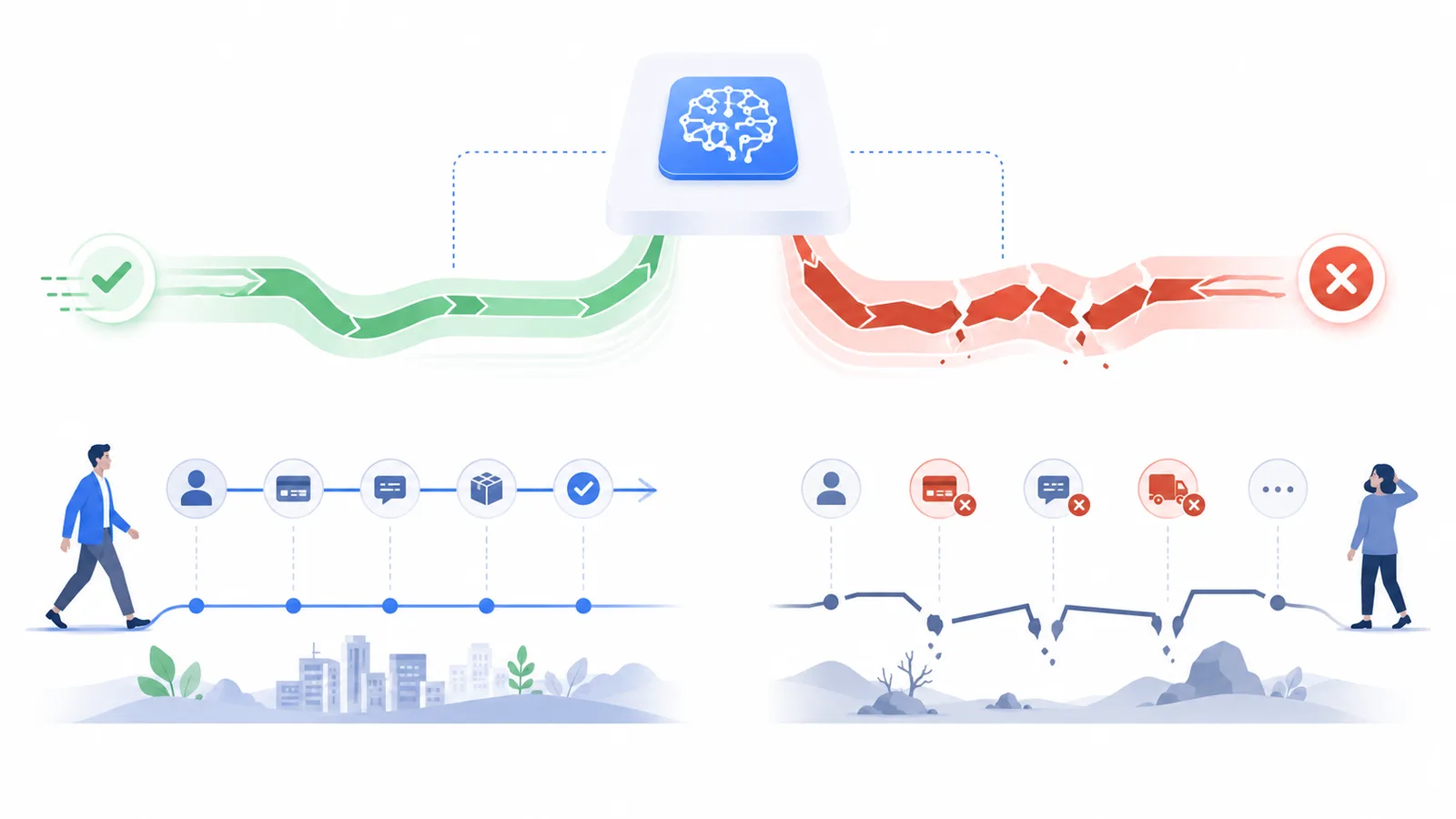
AI can improve B2B customer experience, but only on an experience that works. On a broken one it makes bad service faster. Here is what to fix before you automate.