
A customer signs. Sales moves on. Onboarding sets them up, support fields their questions, an account manager checks in before renewal, finance sends the invoices. Five teams touch that customer after the sale. None of them own the experience. Each works on their piece, and the customer feels every crack between them.
This is where customer experience management breaks. Not in the tools, not in the survey scores. It breaks because no single person is accountable for what the customer actually experiences from contract to renewal. The cost is quiet churn: a customer who goes silent, disengages, and leaves at renewal for a reason nobody saw coming. The decision was made months earlier, in the gaps nobody owned.
What the ownership gap costs you
Put a number on it. Take a B2B firm with 300 accounts at €20K each. Quiet churn runs at 8% a year, so 24 accounts leave without warning. That is €480K of revenue walking out the door, most of it preventable, because these customers did not have a product problem. They had an experience problem: long silences, a clumsy handoff, a renewal conversation that arrived cold.
Cut that quiet churn from 8% to 5% and you save nine accounts a year. At €20K each, that is €180K of protected annual revenue. The numbers here are illustrative; your real baseline comes from your own data. The point holds: the money lost to a fragmented experience is large, and it is recoverable.
Why more tools do not fix it
The common response is to buy software. A CRM to track interactions, a survey platform to measure satisfaction, a help desk to route tickets. Each tool works. Together they produce dashboards. None of them decides what the customer experience should be or holds anyone accountable when it slips.
A survey platform tells you customers are unhappy. It does not tell you who fixes it, by when, or whether the fix worked. Feedback sits in a report. The problem it flagged keeps costing money. You have data about the experience and no owner of the experience. That is the gap a tool cannot close.
What ownership actually looks like
Ownership is not a job title. It is three things working together.
First, one person accountable for the full post-sale journey, with the authority to change it. Not five managers each defending their stage. One owner who sees the whole path the customer walks.
Second, that journey mapped end to end: contract, onboarding, first value, ongoing communication, support, renewal. You map it so you can see where customers stall, where they go quiet, and where one team hands off to another and context gets lost. You cannot fix what you have not traced.
Third, a financial number attached to every change. Not "satisfaction improved." Revenue retained, cost to serve reduced, expansion won. The number is how you know the experience actually improved rather than got busier.
Where the experience usually breaks
Most companies find the same gaps when they look. Onboarding takes longer than sales promised, so the first experience contradicts the pitch. After onboarding, the customer hears nothing until you want to sell them something. When they hit a problem, they explain it to four people and repeat themselves each time. At handoff from one team to another, context disappears and trust erodes.
None of these are product failures. Every one is an experience failure, and every one shows up later as a renewal that does not happen. They are preventable, which means the lost revenue was preventable too.
What to do next
Map the journey your customer walks from the day they sign to the day they renew. Mark every team that touches them and every point where one hands off to another. Then ask one question at each stage: who owns this, and what happens when it goes wrong. If the honest answer at any stage is "nobody, and we wait," you have found a gap that is costing you renewals.
That map is step one. The next step is naming the owner, building the fix for the worst gap, and proving the churn number moved. That is the work: find the problem, build the fix, keep it working.
Frequently asked questions
What is customer experience management?
Who should own customer experience management in a B2B company?
How does poor customer experience management cause churn?
How do you measure customer experience management?
More on Strategy

Will AI Replace Your Customer Experience Team?
No. In B2B, AI takes the routine work and moves your team to design, complex accounts, and overseeing AI. Here is what changes, and why a designed experience matters more.

Do You Need a Customer Experience Consultant or an In-House Team?
Hire a customer experience consultant, build in-house, or buy software? The answer depends on speed, expertise, and whether CX is permanent. Here is how to decide.
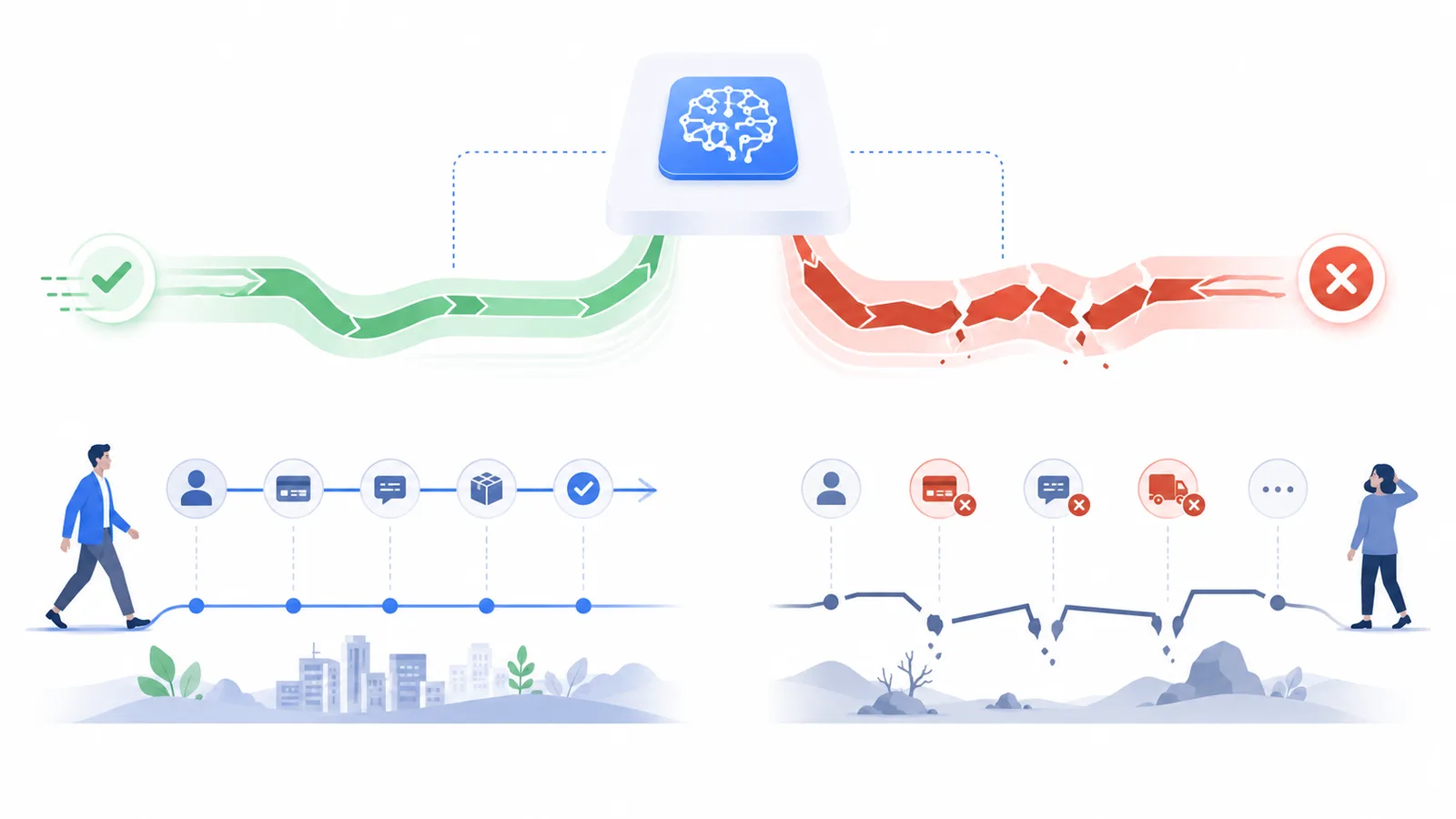
Does AI Improve Customer Experience? Only If You Fix It First
AI can improve B2B customer experience, but only on an experience that works. On a broken one it makes bad service faster. Here is what to fix before you automate.